How to Create a Cryptocurrency Token: Step-by-Step Guide 2026

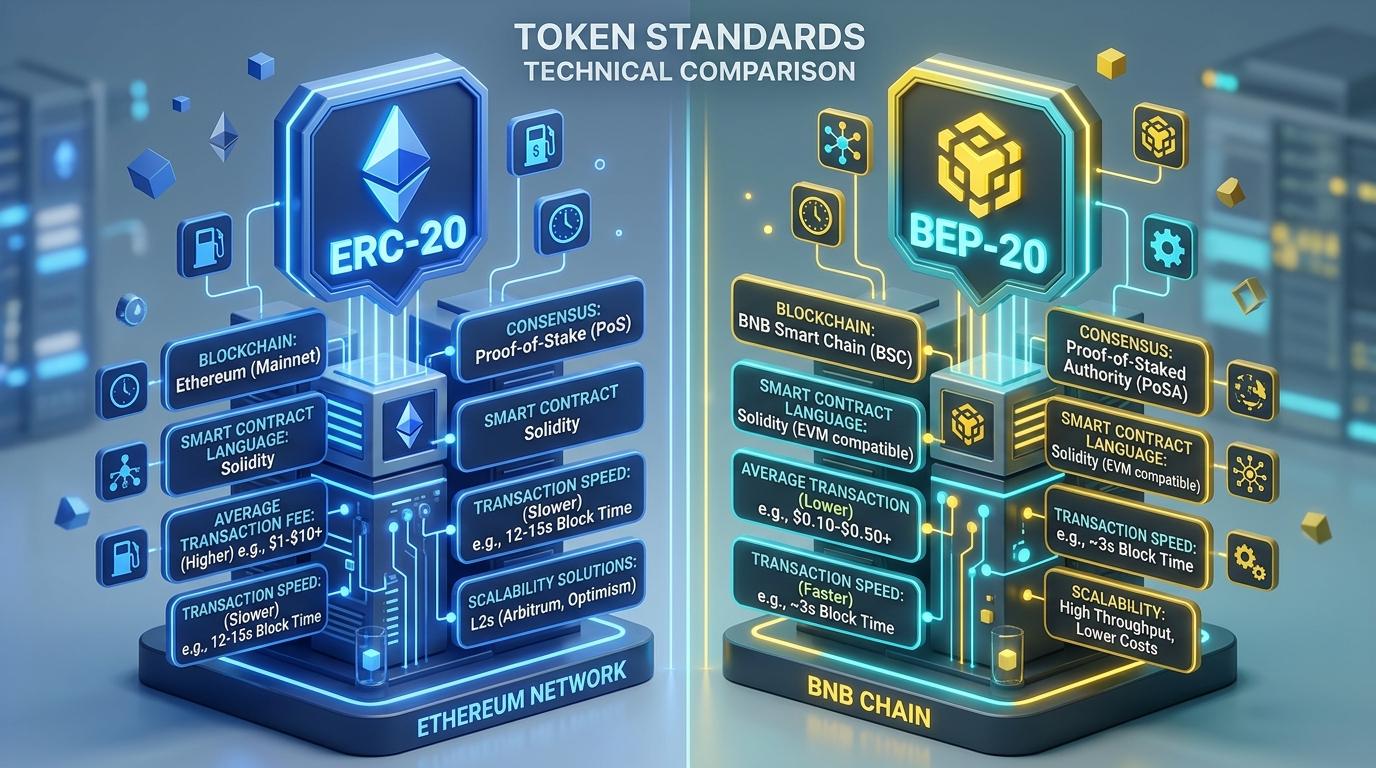
Creating a cryptocurrency token in 2026 is more accessible than ever — but doing it right still requires careful planning. A standard ERC-20 or BEP-20 token can be deployed in 3 to 7 days, while tokens with advanced features like staking, reflection, or deflationary mechanisms take 2 to 4 weeks.
This guide walks you through every step from choosing a blockchain to mainnet deployment, with real cost breakdowns and security considerations.
Step 1: Choose Your Blockchain
The blockchain you choose determines your token's transaction speed, gas costs, ecosystem access, and target audience. Here are the most popular options in 2026:
- Ethereum (ERC-20) — The gold standard. Maximum decentralisation, largest DeFi ecosystem, highest security. Gas fees range from $2 to $50 per transaction depending on network congestion.
- Binance Smart Chain (BEP-20) — EVM-compatible with sub-cent gas fees and 3-second block times. Ideal for cost-sensitive projects and emerging markets.
- Polygon — Ethereum L2 with near-zero fees. Excellent for high-volume applications like gaming tokens or loyalty programs.
- Solana — Sub-second finality with minimal fees. Best for trading platforms and real-time applications.
- Avalanche — Fast with subnet architecture for custom networks. Strong for enterprise and institutional use cases.
Step 2: Design Your Tokenomics
Tokenomics — the economic model of your token — determines its long-term viability. Key decisions include:
- Total supply — Fixed supply (like Bitcoin) creates scarcity. Inflationary supply (like Ethereum post-merge) rewards stakers.
- Distribution — How tokens are allocated: team, investors, community, liquidity, marketing, reserves.
- Vesting schedules — Lock periods for team and investor tokens to prevent dump-and-run scenarios.
- Utility — What the token does: governance voting, staking rewards, platform access, payment currency.
- Burn mechanism — Whether tokens are permanently removed from circulation on each transaction.
Step 3: Develop the Smart Contract
The smart contract is the code that defines your token's behaviour on the blockchain. For ERC-20 and BEP-20 tokens, the standard includes functions for transfer, approval, balance checking, and allowance management.
At Seclob Technologies, we use OpenZeppelin's audited libraries as the foundation and add custom logic for your specific tokenomics. Every contract is developed in Solidity, compiled with Hardhat, and thoroughly tested before deployment.
Common smart contract features and their impact on cost:
- Standard ERC-20/BEP-20 ($1,500–$3,000) — Transfer, approve, mint functions. Straightforward deployment.
- Reflection/reward tokens ($5,000–$10,000) — Automatic redistribution of a percentage of each transaction to holders.
- Deflationary tokens ($3,000–$7,000) — Burn mechanism that reduces supply on each transaction.
- Staking contracts ($5,000–$12,000) — Lock tokens to earn rewards over time with configurable APY.
- Governance tokens ($8,000–$15,000) — Voting mechanisms, proposal creation, and execution logic.
Step 4: Security Audit
Smart contract security is non-negotiable. Once deployed, contracts are immutable — a vulnerability means permanent fund loss. Our security process includes:
- Internal code review for reentrancy, integer overflow, access control, and front-running vulnerabilities
- Automated scanning with Slither and Mythril
- Full testnet deployment with simulated attack scenarios
- Third-party audit coordination (CertiK, Hacken) for high-value projects — typically $5,000 to $30,000 depending on contract complexity
Step 5: Testnet Deployment
Before touching mainnet, every token is deployed on a testnet (Sepolia for Ethereum, BSC Testnet for BNB Chain). This allows full functional testing — transfers, approvals, staking, burning — without risking real funds. We verify all contract functions, gas consumption, and edge cases during this phase.
Step 6: Mainnet Deployment and Verification
Mainnet deployment involves publishing the contract to the live blockchain and verifying the source code on block explorers (Etherscan, BscScan, PolygonScan). Verification makes your contract publicly auditable, which builds investor confidence and is required by most exchanges for listing.
Step 7: Liquidity and Exchange Listing
After deployment, your token needs liquidity to be tradeable:
- DEX listing — Add liquidity on Uniswap, PancakeSwap, or other DEXs. Initial liquidity typically ranges from $5,000 to $50,000 depending on your project scale.
- Liquidity locking — Lock LP tokens for a set period to prove commitment. Services like Team Finance or Unicrypt handle this.
- CEX listing — Centralised exchange listing requires documentation, compliance materials, and often listing fees ranging from $10,000 to $500,000+ depending on the exchange tier.
Total Cost Summary
- Basic token (ERC-20/BEP-20) — $1,500 to $5,000
- Token with advanced features — $5,000 to $20,000
- Full token ecosystem (staking, governance, DeFi) — $25,000+
- Third-party security audit — $5,000 to $30,000
- Initial liquidity — $5,000 to $50,000+
Conclusion
Creating a cryptocurrency token in 2026 is a well-defined process — choose your chain, design tokenomics, develop and audit the smart contract, deploy on testnet then mainnet, and set up liquidity. The total cost ranges from $1,500 for a simple token to $25,000+ for a full ecosystem.
The most important investment is security. A $5,000 audit can prevent a multi-million dollar exploit. If you're planning a token launch, we offer a free technical consultation to help you scope the project and get an accurate quote.
Planning a token launch?
Get a free technical consultation — we'll help you choose the right blockchain, design tokenomics, and provide a transparent quote.
Related Posts